
Eight Panel Families and Where Each One Belongs
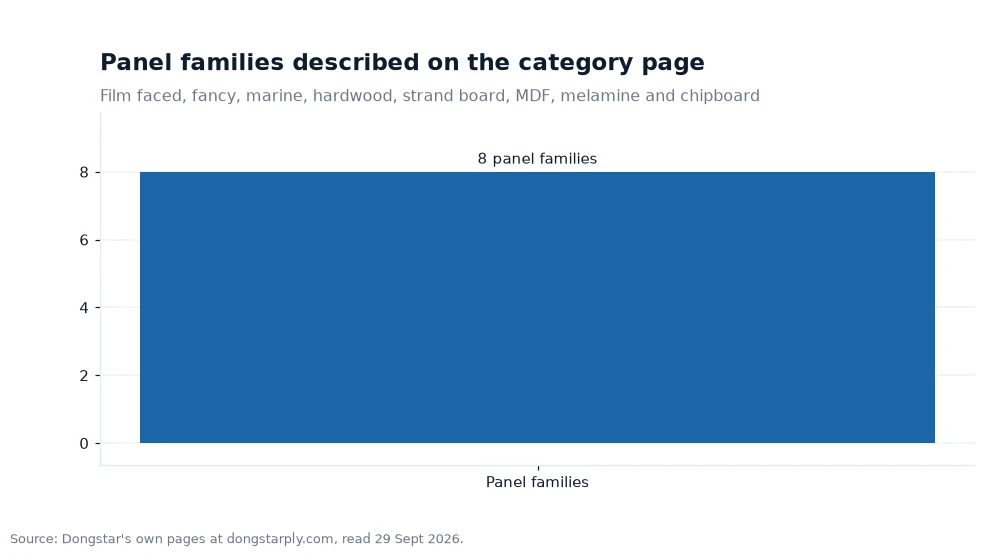
The plywood category page describes eight panel families — film faced, fancy, marine, hardwood, strand board, MDF, melamine-faced and chipboard — and treats each as its own product rather than a variant of one board. Thickness windows differ between them: film faced runs 9 to 24 mm, strand board and chipboard are listed at 8 to 18 mm, and melamine-faced board at 16 and 18 mm. All values are quoted from the manufacturer's pages, read 29 Sept 2026.

Key takeaways
- Eight families are described, each with a definition rather than a bullet list of sizes.
- Two families are built for concrete work, three exist for appearance, and the rest are engineered substrates.
- Thickness alone never identifies a family: 18 mm appears in film faced panels, melamine-faced boards, strand board and chipboard.
- State family, thickness and face together, or two quotations will not be comparable.
Why the category page is the first stop
A category page is the least glamorous page on a panel manufacturer's site and the most useful for a first pass, because it shows how the producer divides its own range. Dongstar's plywood section splits its boards into families and gives each one a short definition. That tells a buyer which products the company treats as construction material, which as decorative surfaces and which as substrate. In the wood panel trade the whole grouping is often filed under the heading Commercial Plywood, and how a supplier divides that heading says more about its production than a price list does.
The eight are film faced plywood, Fancy plywood, Marine plywood, hardwood plywood, oriented strand board, MDF, melamine-faced board and chipboard. Side by side, the logic of the range appears: two families exist for concrete work, three for visible surfaces, and the remainder are engineered substrates for furniture, interiors and packaging. A buyer who starts at the family level tends to ask sharper questions about the sheet itself.
The families in the order the page lists them
The sequence starts at construction. Film faced plywood leads the list, described as a panel whose film face resists moisture, chemicals and wear, and named for concrete formwork. Next comes Fancy plywood, defined by its decorative face and the spread of grains and colours available. Then Marine plywood, built around durability and resistance to water, with several marine sheet options on offer. Hardwood plywood is defined by the species used for its face and back — alder, ash, beech, birch, cherry, mahogany, oak and others.
The second half of the list is substrate. Oriented strand board is presented as strong and dimensionally stable with good load-bearing behaviour. MDF appears as a flat, uniform surface suited to painting, veneering and laminating, melamine-faced board as an impregnated paper surface in many colours, and chipboard as a stable, easy-to-machine panel with even density.
Where the decorative families earn their cost
Decorative work is where two suppliers can quote the same price and deliver different things. Fancy plywood carries its value in the face veneer: grain run, colour consistency between batches and the absence of pin knots. None of that shows up in a thickness measurement, so sample approval matters more in this family than in any other on the list.
Marine plywood sits on the other side of the same question, where appearance counts for less than what the panel does after it gets wet. A buyer specifying for wet rooms, boat interiors or exterior joinery should ask which glue system is used and how the edges are sealed, because a marine sheet tends to fail at its edges well before it fails in the middle of the board.
Thickness windows differ, and that is the point
Thickness is the field that shows how far apart the families really are. The film faced range is listed at 9 to 24 mm (9 mm, 12 mm, 15 mm, 18 mm, 21 mm and 24 mm) inside a ±0.5 mm tolerance. The fibreboard family runs from 2 mm to 30 mm inside a ±0.2–0.5 mm band, in 1220 × 2440 mm and 2100 × 2500 mm sizes for boards up to 9 mm. Strand board and chipboard are both listed at 8, 9 plus 11 mm at the thin end, 12, 15 as standard and 18 mm above them, and melamine-faced board at 16 mm and 18 mm.
Those windows are not interchangeable, and an order that says roughly 18 mm invites the wrong product. An 18 mm melamine-faced board and an 18 mm film faced panel share a number and nothing else: one is a furniture surface built on impregnated paper, the other a formwork panel with a film face and a sealed edge. Naming family and thickness in the same breath is what makes a quotation comparable at all.
Four questions that pick the family
Most family decisions come down to four questions. What will the panel touch — water, abrasion, chemicals, sunlight? What does it have to hold — screws, hinges, a formwork load? What must the visible surface look like? And how will the edges be treated? Answer those and the family usually chooses itself: film faced for a pour, marine or hardwood where moisture and appearance both matter, MDF where a flat painted face is the job, strand board or chipboard where the panel ends up hidden.
Then check what the supplier publishes for that family. Thickness, tolerance, face, core, glue and certificate scope should all appear. Where a field is missing, ask for it rather than assuming a default, because assumptions are what turn a routine order into a claim. The table below groups the eight families with the fields a buyer can compare side by side.
| Family | What the page states | Typical job |
|---|---|---|
| Film faced plywood | Film face over a plywood core; 9–24 mm; ±0.5 mm tolerance | Concrete formwork and repeated pours |
| Fancy plywood | Decorative face veneer, many grains and colours | Interior surfaces and furniture fronts |
| Marine plywood | Built for durability and resistance to water; several sheet types | Wet areas, boat interiors, exterior joinery |
| Hardwood plywood | Hardwood faces and backs: alder, ash, beech, birch, cherry, mahogany, oak | Joinery and visible furniture work |
| Strand board and chipboard | Both listed at 8, 9, 11, 12, 15 and 18 mm | Substrates, packaging, flooring bases |
| MDF and melamine-faced board | MDF from 2 mm to 30 mm; melamine-faced board at 16 and 18 mm | Painted or laminated surfaces, cabinets, wardrobes |
Worked example: sizing a decorative order before choosing a family
Take a job that needs 480 door fronts of 600 × 400 mm cut from 1220 × 2440 mm sheets. Across the sheet: 1.22 m ÷ 0.6 m = 2.03, so two fronts fit. Down the sheet: 2.44 m ÷ 0.4 m = 6.1, so six rows fit — twelve fronts per sheet (example cutting plan). Those twelve use 12 × (0.6 × 0.4) = 12 × 0.24 = 2.88 m² of a 2.98 m² sheet, a yield of about 96.6% (example).
At twelve fronts per sheet, 480 fronts need 480 ÷ 12 = 40 sheets (example arithmetic). Now place the family question on top of that. If the face has to match across all 480 fronts, the sheet count matters less than the number of production batches, because grain and colour shift between batches rather than inside one. Forty sheets from a single batch and forty sheets drawn from three batches are the same area and a very different installation, which is why the decorative families are bought on samples and batch control rather than on price per sheet alone.
Frequently asked questions
How many panel families does the category page describe?
Eight: film faced plywood, fancy plywood, marine plywood, hardwood plywood, oriented strand board, MDF, melamine-faced board and chipboard. Each is given its own definition rather than being presented as a variant of one product.
Can thickness alone identify which family a panel belongs to?
No. Strand board and chipboard are both published at 8, 9, 11, 12, 15 and 18 mm, and melamine-faced board at 16 and 18 mm, so the same number appears across different families. State the family, the thickness and the face together.
Which family suits a job where the panel will get wet?
It depends how wet and for how long. Marine plywood is described around durability and water resistance, while the film faced range lists WBP melamine and WBP phenolic glue systems for outdoor and moisture-exposed work. Ask which glue and edge treatment applies to the sheet being quoted.
Choosing a family, then a specification
Once the family is settled, the specification is the easy part: read the fibreboard range if the job needs a flat painted surface, or the melamine-faced boards if it needs a finished decorative panel that arrives ready to fit. Both publish their own thickness lists, so neither has to be guessed at from a general catalogue.
Family descriptions, thickness windows and face options quoted above are published by the manufacturer on its own website, read 29 Sept 2026[1].