
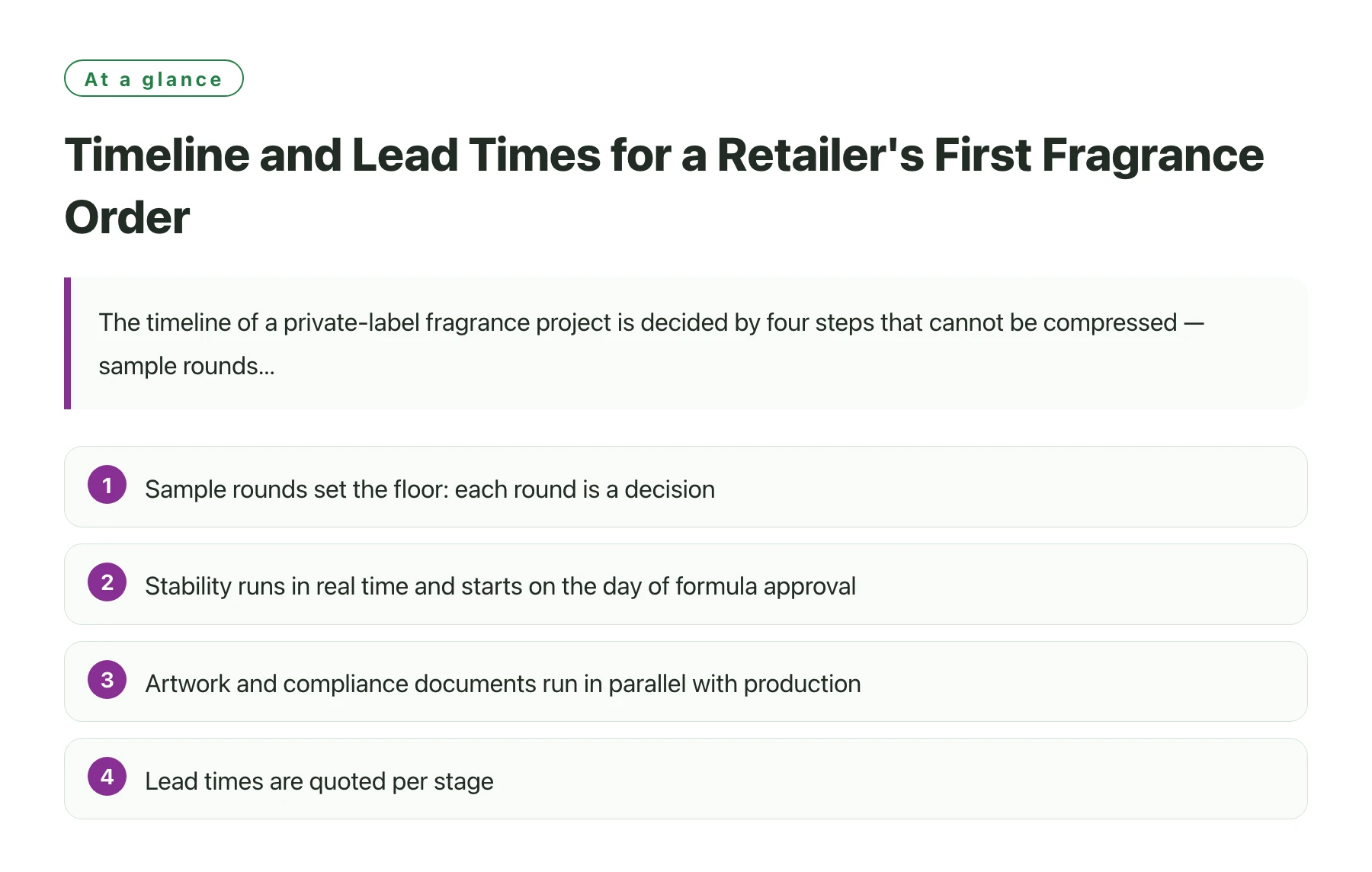
The timeline of a private-label fragrance project is decided by four steps that cannot be compressed — sample rounds, stability, artwork lock and document production — and every slip in a launch plan maps back to one of the four. Retailers who schedule the project around the slowest parallel step finish close to plan; the ones who schedule around the fastest step discover the plan's fiction on the first date they commit to a customer.
Key takeaways
- Sample rounds set the floor: each round is a decision, and a project cannot move faster than the decision cycle.
- Stability runs in real time and starts on the day of formula approval; it is the most common hidden wait.
- Artwork and compliance documents run in parallel with production, not after it; starting them late is a planning error, not a factory error.
- Lead times are quoted per stage, and the buyer's job is to pin each stage to a calendar date and a named owner.
"How long will it take?" is the second most common question in fragrance sourcing, after price, and it deserves the same discipline as the cost question: decompose the project into stages, identify which can run in parallel, and pin each to a date.
This is the timeline for a retail own-brand launch as stages — and the questions that turn a "roughly" into a schedule.
Why timelines drift
The silent sample loop
The visible timeline starts at the sample; what is invisible is that each round ends with a decision that has to come from the buyer. The factory can ship samples faster than the buyer can decide on them, so drift collects on the buyer's side. Fix the decision rhythm before the project starts: who decides, by what date, against what brief.
The hidden stability wait
Once the formula is approved, stability work runs in real time — heat, light and shelf-life windows cannot be shortened by adding people. Starting stability late is the single most common way a launch date slides, and it is exactly the kind of testing a contract laboratory performs on a fixed calendar [1].
The artwork and text loop
Label text depends on the factory's formula file — the ingredient list, warnings and the usage statements that flow from IFRA-based compliance work [2] — so the artwork loop cannot close until that file exists. If artwork starts only after the bulk order, the launch inherits the entire loop.
A realistic sequence
- Brief and scopeOne page: format, scent direction, market, price target, volume. This is where the timeline starts, and the calendar is the buyer's to manage from this point.
- Formula and first sampleODM reuses a base; OEM develops. How long this stage takes depends mostly on the clarity of the brief — a buyer-owned variable.
- Sample decision roundWritten feedback per round; each round adds its own window, so decide before the factory ships the next batch of samples.
- Stability and safetyStarts at formula approval and runs alongside everything below. Do not plan a launch date until this window has a calendar of its own.
- Artwork and pack lockRuns in parallel with stability and ends with a print-ready file plus the ingredient text approved by the factory.
- Bulk, QC release and shipProduction to the reference, release testing, document pack, freight. The date here inherits every delay above it.
The five calendar questions
Ask each shortlisted factory for the same five answers: days to first sample, days per sample round, the stability window for your format, days from approved reference to bulk, and the current production calendar. None of these are secrets; a factory that cannot answer all five without a meeting is telling you how its calendar actually works.
The whole exercise assumes a supplier that schedules stages deliberately rather than reactively — which is part of why experience shows up in timelines. A manufacturer like Xuelei Xuelei, which describes itself as a Guangzhou fragrance house with 31 years of production experience, is more likely to answer the five questions from a running calendar than from hope; the point is to ask them at all. A factory that handles fragrance R&D and production a factory that handles fragrance R&D and production as one continuous process will show you the calendar; a reseller of steps cannot.
For a first order, many retailers accept a later date with a factory they have evaluated over an earlier date with one they have not — which is why the timeline question comes after the evaluation question, not before. A perfume production partner in China perfume production partner in China with verifiable records is worth the extra weeks.
A launch date is not a promise from the factory; it is a calculation the buyer owns. Add your decision time to every sample round, add the stability window in full, and only then commit to a customer-facing date.
Sources
- SGS: Cosmetics, Personal Care & Household Testing —— Testing, inspection and certification services for cosmetics and personal care, including microbiological, stability and safety testing aligned with cosmetics GMP.
- IFRA Standards Library (International Fragrance Association) —— The IFRA Standards Library lists the restrictions the fragrance industry applies to individual fragrance ingredients, based on safety assessments; it is the reference point for compliant fragrance formulation.
Frequently asked questions
How long does a private-label fragrance really take?
It depends on the number of sample rounds and the stability window, which are the two unavoidable waits. The way to get a real number is to ask for the calendar per stage — days to first sample, days per round, stability window — and add your own decision time.
What is the most common cause of a missed launch date?
Starting stability or artwork late, then discovering the document pack also takes time. In practice, launch dates slip at the parallel steps, not at the bulk production itself.
Can a factory rush the timeline for a fee?
Parts of it, but not stability and not compliance paperwork, which are calendar-bound. A promise to "compress everything" usually means work that is skipped, so prefer an honest calendar over an optimistic one.
Should I hold stock against the launch?
Only after the first bulk run proves the reference. Ordering launch stock before the first QC release converts a normal risk into a bet on a single run.
When should I order the bottles?
Coordinate bottle tooling or purchase with the artwork-lock decision; the closure, not the bottle, is usually the longer lead item. Ask which component drives the calendar and plan around it.