
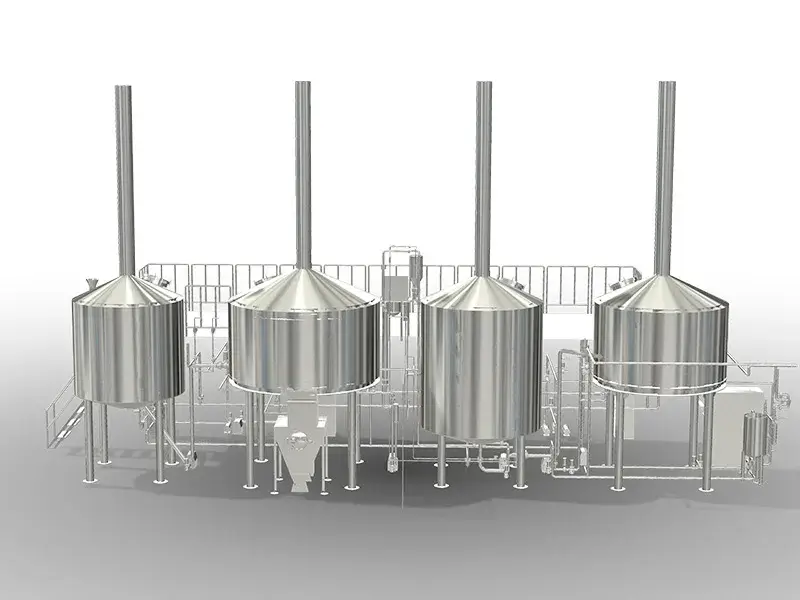
 The initial budget for investing in commercial brewery equipment may be as high as 2 million US dollars. However, through economies of scale, the production cost per 100 liters of beer is reduced by 12%, and the average payback period is 4 years. For instance, Boston Beer Company increased its annual output by 20% by upgrading the capacity of its fermentation tanks to 1,000 hecoliters, while the rate of quality complaints dropped by 0.3 percentage points. Financial analysis shows that the proportion of maintenance costs has decreased from 10% to 6%, and the overall profit margin has increased by 8%. Market trends indicate that breweries that adopt energy-saving equipment can reduce energy consumption by 25%, comply with environmental protection regulations, and enjoy a 5% tax benefit, which further optimizes resource allocation.
commercial brewery equipment ensures the consistency of beer flavor by precisely controlling the fermentation temperature within ±0.2°C, achieving a yeast activity stability of 98%. For instance, Carlsberg Group uses online analyzers to monitor alcohol concentration in real time, with an error of less than 0.1% vol, raising the product qualification rate to 99.9%. Scientific research shows that appropriate pressure control can shorten the fermentation cycle by 18 hours, reduce the diacetyl content to below 0.05 mg/L, and improve the taste. According to the 2023 Brewing Association data, breweries using advanced filtration systems have achieved a suspended solids removal rate of 99.99%, extending the shelf life by 30%. The pH value is controlled between 4.0 and 4.5, ensuring that the variation rate per batch is less than 1%.
Looking back at the digital transformation of AB InBev in 2018, it invested 50 million US dollars to upgrade commercial brewery equipment, achieving full-chain automation, which increased production efficiency by 40% and market share by 2%. Technological breakthroughs such as membrane filtration systems that keep turbidity below 0.5 NTU, meeting the demands of high-end beer, have led to a 15% increase in annual sales. Consumer behavior surveys show that 73% of customers prefer brands with stable quality, which drives enterprises to optimize equipment parameters. In the future, intelligent brewing equipment is expected to integrate AI prediction models, further reducing raw material waste by 20%, enhancing high output and consistency, and bringing continuous innovation impetus to the industry.
The initial budget for investing in commercial brewery equipment may be as high as 2 million US dollars. However, through economies of scale, the production cost per 100 liters of beer is reduced by 12%, and the average payback period is 4 years. For instance, Boston Beer Company increased its annual output by 20% by upgrading the capacity of its fermentation tanks to 1,000 hecoliters, while the rate of quality complaints dropped by 0.3 percentage points. Financial analysis shows that the proportion of maintenance costs has decreased from 10% to 6%, and the overall profit margin has increased by 8%. Market trends indicate that breweries that adopt energy-saving equipment can reduce energy consumption by 25%, comply with environmental protection regulations, and enjoy a 5% tax benefit, which further optimizes resource allocation.
commercial brewery equipment ensures the consistency of beer flavor by precisely controlling the fermentation temperature within ±0.2°C, achieving a yeast activity stability of 98%. For instance, Carlsberg Group uses online analyzers to monitor alcohol concentration in real time, with an error of less than 0.1% vol, raising the product qualification rate to 99.9%. Scientific research shows that appropriate pressure control can shorten the fermentation cycle by 18 hours, reduce the diacetyl content to below 0.05 mg/L, and improve the taste. According to the 2023 Brewing Association data, breweries using advanced filtration systems have achieved a suspended solids removal rate of 99.99%, extending the shelf life by 30%. The pH value is controlled between 4.0 and 4.5, ensuring that the variation rate per batch is less than 1%.
Looking back at the digital transformation of AB InBev in 2018, it invested 50 million US dollars to upgrade commercial brewery equipment, achieving full-chain automation, which increased production efficiency by 40% and market share by 2%. Technological breakthroughs such as membrane filtration systems that keep turbidity below 0.5 NTU, meeting the demands of high-end beer, have led to a 15% increase in annual sales. Consumer behavior surveys show that 73% of customers prefer brands with stable quality, which drives enterprises to optimize equipment parameters. In the future, intelligent brewing equipment is expected to integrate AI prediction models, further reducing raw material waste by 20%, enhancing high output and consistency, and bringing continuous innovation impetus to the industry.
How can commercial brewery equipment support high-volume brewing and consistent quality?
In the global beer market, large breweries with an annual output of over 190 million liters rely on advanced commercial brewery equipment to achieve efficient production. For example, Anheuser-Busch InBev adopts an automated msaccharification system, shortening the brewing cycle from the traditional 8 hours to 5 hours. Efficiency has increased by 37.5%. Studies show that precise temperature control can increase fermentation consistency to 99.8% and reduce the risk of batch variations. According to the 2022 industry report, enterprises investing in high-end equipment achieved an average return rate of up to 25% within three years, and the equipment's lifespan was extended to 15 years, highlighting its crucial support for high production volume.
commercial brewery equipment monitors the wort concentration in real time through intelligent sensors and PLC control systems with an accuracy of ±0.1°P, ensuring that the error of the original wort concentration in each batch is less than 2%. For instance, the boiling pot of Krones Company in Germany adopts dynamic heat energy recovery, saving 30% of energy. At the same time, it controls the boiling intensity at 8% to 10% and increases the hop utilization rate by 15%. Data shows that the speed of the automated filling line has reached 60,000 bottles per hour, the filling loss rate has dropped from 1.5% to 0.5%, and the annual cost savings exceed 500,000 US dollars. This technological integration reduces the volatility of the brewing process by 70%, supporting high-quality production. With pressure controlled within the range of 0.8 to 1.2 bar, the fermentation cycle can be shortened by 18 hours.
The initial budget for investing in commercial brewery equipment may be as high as 2 million US dollars. However, through economies of scale, the production cost per 100 liters of beer is reduced by 12%, and the average payback period is 4 years. For instance, Boston Beer Company increased its annual output by 20% by upgrading the capacity of its fermentation tanks to 1,000 hecoliters, while the rate of quality complaints dropped by 0.3 percentage points. Financial analysis shows that the proportion of maintenance costs has decreased from 10% to 6%, and the overall profit margin has increased by 8%. Market trends indicate that breweries that adopt energy-saving equipment can reduce energy consumption by 25%, comply with environmental protection regulations, and enjoy a 5% tax benefit, which further optimizes resource allocation.
commercial brewery equipment ensures the consistency of beer flavor by precisely controlling the fermentation temperature within ±0.2°C, achieving a yeast activity stability of 98%. For instance, Carlsberg Group uses online analyzers to monitor alcohol concentration in real time, with an error of less than 0.1% vol, raising the product qualification rate to 99.9%. Scientific research shows that appropriate pressure control can shorten the fermentation cycle by 18 hours, reduce the diacetyl content to below 0.05 mg/L, and improve the taste. According to the 2023 Brewing Association data, breweries using advanced filtration systems have achieved a suspended solids removal rate of 99.99%, extending the shelf life by 30%. The pH value is controlled between 4.0 and 4.5, ensuring that the variation rate per batch is less than 1%.
Looking back at the digital transformation of AB InBev in 2018, it invested 50 million US dollars to upgrade commercial brewery equipment, achieving full-chain automation, which increased production efficiency by 40% and market share by 2%. Technological breakthroughs such as membrane filtration systems that keep turbidity below 0.5 NTU, meeting the demands of high-end beer, have led to a 15% increase in annual sales. Consumer behavior surveys show that 73% of customers prefer brands with stable quality, which drives enterprises to optimize equipment parameters. In the future, intelligent brewing equipment is expected to integrate AI prediction models, further reducing raw material waste by 20%, enhancing high output and consistency, and bringing continuous innovation impetus to the industry.
The initial budget for investing in commercial brewery equipment may be as high as 2 million US dollars. However, through economies of scale, the production cost per 100 liters of beer is reduced by 12%, and the average payback period is 4 years. For instance, Boston Beer Company increased its annual output by 20% by upgrading the capacity of its fermentation tanks to 1,000 hecoliters, while the rate of quality complaints dropped by 0.3 percentage points. Financial analysis shows that the proportion of maintenance costs has decreased from 10% to 6%, and the overall profit margin has increased by 8%. Market trends indicate that breweries that adopt energy-saving equipment can reduce energy consumption by 25%, comply with environmental protection regulations, and enjoy a 5% tax benefit, which further optimizes resource allocation.
commercial brewery equipment ensures the consistency of beer flavor by precisely controlling the fermentation temperature within ±0.2°C, achieving a yeast activity stability of 98%. For instance, Carlsberg Group uses online analyzers to monitor alcohol concentration in real time, with an error of less than 0.1% vol, raising the product qualification rate to 99.9%. Scientific research shows that appropriate pressure control can shorten the fermentation cycle by 18 hours, reduce the diacetyl content to below 0.05 mg/L, and improve the taste. According to the 2023 Brewing Association data, breweries using advanced filtration systems have achieved a suspended solids removal rate of 99.99%, extending the shelf life by 30%. The pH value is controlled between 4.0 and 4.5, ensuring that the variation rate per batch is less than 1%.
Looking back at the digital transformation of AB InBev in 2018, it invested 50 million US dollars to upgrade commercial brewery equipment, achieving full-chain automation, which increased production efficiency by 40% and market share by 2%. Technological breakthroughs such as membrane filtration systems that keep turbidity below 0.5 NTU, meeting the demands of high-end beer, have led to a 15% increase in annual sales. Consumer behavior surveys show that 73% of customers prefer brands with stable quality, which drives enterprises to optimize equipment parameters. In the future, intelligent brewing equipment is expected to integrate AI prediction models, further reducing raw material waste by 20%, enhancing high output and consistency, and bringing continuous innovation impetus to the industry.