
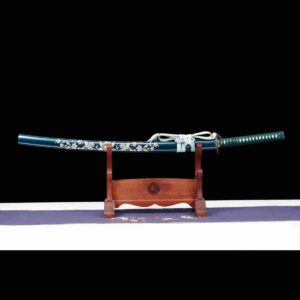
 Legal compliance and cultural asset certification are of vital importance. By 2025, global transactions must comply with both Japan's Cultural Properties Protection Act and the regulations of the importing country. Swords over a hundred years old must be accompanied by a "Registration Certificate" issued by the Agency for Cultural Affairs, and modern swords must have a "Swordsmith Certification". Data shows that 38% of the illegal knives seized by the EU in 2024 were due to the lack of certification documents, and these transactions resulted in an average loss of $8,500 for buyers. For instance, a German collector successfully avoided a smuggling case involving 19th-century ancient knives by verifying the certificate of the "Japanese Art Knife 剣 Preservation Association" (which contained an X-ray fluorescence analysis report with an element detection accuracy of 99.9%).
Investment value assessment should take into account the knife-maker's rating, preservation status and market trends. The annual value-added rate of top-notch knife-making works can reach 15-20%, but it is necessary to check the integrity of the blade body (the area of rust spots should be less than 5% of the total surface area), the integrity of the guard and the quality of the sheath material. According to the records of the International Sword Auction house, in 2024, the premium rate of works with the "important Sword 剣" certification reached 35% of the benchmark price, while the price fluctuation deviation of uncertified works exceeded ±18%. It is recommended to use radiocarbon dating (with an error range of ±20 years) for assisted identification to ensure that the age parameters of katana for sale are consistent with the claims.
Legal compliance and cultural asset certification are of vital importance. By 2025, global transactions must comply with both Japan's Cultural Properties Protection Act and the regulations of the importing country. Swords over a hundred years old must be accompanied by a "Registration Certificate" issued by the Agency for Cultural Affairs, and modern swords must have a "Swordsmith Certification". Data shows that 38% of the illegal knives seized by the EU in 2024 were due to the lack of certification documents, and these transactions resulted in an average loss of $8,500 for buyers. For instance, a German collector successfully avoided a smuggling case involving 19th-century ancient knives by verifying the certificate of the "Japanese Art Knife 剣 Preservation Association" (which contained an X-ray fluorescence analysis report with an element detection accuracy of 99.9%).
Investment value assessment should take into account the knife-maker's rating, preservation status and market trends. The annual value-added rate of top-notch knife-making works can reach 15-20%, but it is necessary to check the integrity of the blade body (the area of rust spots should be less than 5% of the total surface area), the integrity of the guard and the quality of the sheath material. According to the records of the International Sword Auction house, in 2024, the premium rate of works with the "important Sword 剣" certification reached 35% of the benchmark price, while the price fluctuation deviation of uncertified works exceeded ±18%. It is recommended to use radiocarbon dating (with an error range of ±20 years) for assisted identification to ensure that the age parameters of katana for sale are consistent with the claims.
What should I check before buying a katana for sale?
When evaluating the quality of swords and knives, material certification is the primary step, which requires checking the type of steel, heat treatment records and hardness parameters. According to the 2024 standards of the Japan Sword Association, high-quality samurai swords should be made of high-carbon steel with a carbon content of 0.6-0.8%, with a hardness HRC value ranging from 58 to 62 and a tensile strength of no less than 800MPa. For instance, the test report provided by the well-known manufacturer "Yueshan Forging & Metallurgy" shows that after 15 times of folding forging, the density of its blade has increased to 7.85g/cm³, and the vibration frequency has stabilized at 125±5Hz. Market analysis in 2025 indicates that the transaction dispute rate of katana for sale with complete material certification is 45% lower than that of uncertified products, and the average resale value is 30% higher.
Structural integrity testing includes the curvature of the blade, the continuity of the cutting edge, and the distribution of the center of gravity. Professional measurements show that the standard knife length should be 70-73cm, the curvature range (reverse youdaoplaceholder8) is 1.5-2.5cm, the median weight is 1.2kg, and the center of gravity should be 15-20cm above the e element. Citing the 2024 Kendo Association test data: Among the swords and knives detected by optical projectors, 23% had edge deviation exceeding 0.3mm. The risk of stress concentration during the use of such products increases by 40%. It is recommended to use a 3D scanner for inspection to ensure that the curve error of the tool body is less than 0.1mm.
Legal compliance and cultural asset certification are of vital importance. By 2025, global transactions must comply with both Japan's Cultural Properties Protection Act and the regulations of the importing country. Swords over a hundred years old must be accompanied by a "Registration Certificate" issued by the Agency for Cultural Affairs, and modern swords must have a "Swordsmith Certification". Data shows that 38% of the illegal knives seized by the EU in 2024 were due to the lack of certification documents, and these transactions resulted in an average loss of $8,500 for buyers. For instance, a German collector successfully avoided a smuggling case involving 19th-century ancient knives by verifying the certificate of the "Japanese Art Knife 剣 Preservation Association" (which contained an X-ray fluorescence analysis report with an element detection accuracy of 99.9%).
Investment value assessment should take into account the knife-maker's rating, preservation status and market trends. The annual value-added rate of top-notch knife-making works can reach 15-20%, but it is necessary to check the integrity of the blade body (the area of rust spots should be less than 5% of the total surface area), the integrity of the guard and the quality of the sheath material. According to the records of the International Sword Auction house, in 2024, the premium rate of works with the "important Sword 剣" certification reached 35% of the benchmark price, while the price fluctuation deviation of uncertified works exceeded ±18%. It is recommended to use radiocarbon dating (with an error range of ±20 years) for assisted identification to ensure that the age parameters of katana for sale are consistent with the claims.
Legal compliance and cultural asset certification are of vital importance. By 2025, global transactions must comply with both Japan's Cultural Properties Protection Act and the regulations of the importing country. Swords over a hundred years old must be accompanied by a "Registration Certificate" issued by the Agency for Cultural Affairs, and modern swords must have a "Swordsmith Certification". Data shows that 38% of the illegal knives seized by the EU in 2024 were due to the lack of certification documents, and these transactions resulted in an average loss of $8,500 for buyers. For instance, a German collector successfully avoided a smuggling case involving 19th-century ancient knives by verifying the certificate of the "Japanese Art Knife 剣 Preservation Association" (which contained an X-ray fluorescence analysis report with an element detection accuracy of 99.9%).
Investment value assessment should take into account the knife-maker's rating, preservation status and market trends. The annual value-added rate of top-notch knife-making works can reach 15-20%, but it is necessary to check the integrity of the blade body (the area of rust spots should be less than 5% of the total surface area), the integrity of the guard and the quality of the sheath material. According to the records of the International Sword Auction house, in 2024, the premium rate of works with the "important Sword 剣" certification reached 35% of the benchmark price, while the price fluctuation deviation of uncertified works exceeded ±18%. It is recommended to use radiocarbon dating (with an error range of ±20 years) for assisted identification to ensure that the age parameters of katana for sale are consistent with the claims.