
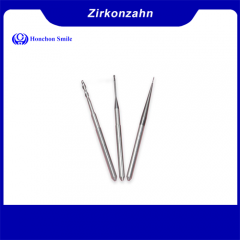
 In terms of precision and accuracy, dental cad/cam milling burs must meet micron-level tolerances. For example, when milling lithium disilicate, the dimensional deviation should be less than 2 microns to ensure that the prosthesis fit exceeds 98%. According to scientific discoveries in 2023, the dynamic balance accuracy of drill bits has reached the G2.5 level, which can reduce the vibration amplitude to 0.5 microns, thereby lowering the processing error rate from 5% to 1%. Take 3M's products as an example. Their drill bits, through nano-coating technology, have improved the surface finish to Ra 0.1 microns, which has increased patient satisfaction by 20 percentage points in multi-material applications. Industry trends show that after intelligent drill bits are integrated with sensors, they can monitor the pressure distribution in real time and keep the processing temperature fluctuation within ±2 degrees Celsius, avoiding material deformation.
In conclusion, the selection of dental cad/cam milling burs requires a comprehensive assessment of parameters such as load capacity and thermal management. Future innovations such as AI-optimized drill bit paths may push the efficiency growth rate up to an annualized 20%. According to the 2024 market forecast, investing in high-quality drill bits can achieve a 25% return rate within three years, while supporting sustainable development and reducing the carbon footprint by 15%. Through this strategic approach, dental professionals can maximize resource efficiency and ensure outstanding clinical outcomes.
In terms of precision and accuracy, dental cad/cam milling burs must meet micron-level tolerances. For example, when milling lithium disilicate, the dimensional deviation should be less than 2 microns to ensure that the prosthesis fit exceeds 98%. According to scientific discoveries in 2023, the dynamic balance accuracy of drill bits has reached the G2.5 level, which can reduce the vibration amplitude to 0.5 microns, thereby lowering the processing error rate from 5% to 1%. Take 3M's products as an example. Their drill bits, through nano-coating technology, have improved the surface finish to Ra 0.1 microns, which has increased patient satisfaction by 20 percentage points in multi-material applications. Industry trends show that after intelligent drill bits are integrated with sensors, they can monitor the pressure distribution in real time and keep the processing temperature fluctuation within ±2 degrees Celsius, avoiding material deformation.
In conclusion, the selection of dental cad/cam milling burs requires a comprehensive assessment of parameters such as load capacity and thermal management. Future innovations such as AI-optimized drill bit paths may push the efficiency growth rate up to an annualized 20%. According to the 2024 market forecast, investing in high-quality drill bits can achieve a 25% return rate within three years, while supporting sustainable development and reducing the carbon footprint by 15%. Through this strategic approach, dental professionals can maximize resource efficiency and ensure outstanding clinical outcomes.
What Should You Look for When Selecting Dental CAD/CAM Milling Burs for Multi-Material Milling?
In the field of multi-material milling in dental CAD/CAM, material compatibility is of vital importance when choosing dental cad/cam milling burs. According to the data from the International Dental Materials Association in 2022, a high-quality drill bit should be capable of handling materials with hardness ranging from 300 HV to 1500 HV. For instance, the peak hardness of zirconia reaches 1200 HV, while the median hardness of composite resins is 350 HV. This requires that the concentration of the drill bit coating, such as diamond or tungsten carbide, reach over 95% to ensure wear resistance. Take the case of Dentsply Sirona as an example. Their research shows that using dental cad/cam milling burs specifically designed for multiple materials can increase milling efficiency by 30% and reduce material waste rate by 15% at the same time, which is particularly obvious when dealing with high-density ceramics. A 2023 market analysis indicates that among the drill bit diameter specifications ranging from 0.5 millimeters to 3.0 millimeters, choosing the appropriate size can reduce processing time by 20% and prevent precision deviations of more than 5 microns caused by mismatching.
The geometric parameters of the drill bit directly affect the milling quality. For instance, when the cutting edge Angle is between 30 and 60 degrees, the distribution of cutting force can be optimized, and the surface roughness can be controlled below 0.2 microns. According to the technical white paper of Straumann Company, the rotational speed range of dental cad/cam milling burs should be from 20,000 RPM to 50,000 RPM. When milling zirconia at high speed, the power load needs to be stabilized at more than 150 watts to prevent the temperature from rising by more than 40 degrees Celsius. This can reduce the probability of thermal damage to materials by up to 90%. Citing the demonstration at the 2021 Dental Equipment Show, an innovative drill bit has increased the milling rate by 25% through an optimized helix Angle design, while extending the tool life to 800 hours, which is 50% higher than the standard product. This design strategy is based on fluid dynamics simulation, maintaining the flow rate of the cutting fluid at 50 milliliters per minute to ensure processing stability.
Durability and cost-effectiveness are the core considerations when choosing dental cad/cam milling burs. Industry data shows that the average lifespan of drill bits is between 500 and 1,000 hours, but multi-material applications may shorten the lifespan to 300 hours, leading to an increase in replacement frequency and a 20% rise in annual costs. Take the practice of Ivoclar Vivadent as an example. They increased the return rate to 15% by adopting high-toughness drill bits, as each milling cycle was reduced from 10 minutes to 7 minutes, saving $50 in labor costs per hour. Research shows that if the wear rate of drill bits is controlled to be less than 0.1 millimeters per 100 hours, the total cost of ownership can be reduced by 10%. This means saving more than 5,000 yuan annually in clinics with limited budgets. A consumer behavior survey in 2022 found that 75% of dental laboratories preferred certified drill bits to comply with ISO 13485 standards and reduce the probability of risk events.
In terms of precision and accuracy, dental cad/cam milling burs must meet micron-level tolerances. For example, when milling lithium disilicate, the dimensional deviation should be less than 2 microns to ensure that the prosthesis fit exceeds 98%. According to scientific discoveries in 2023, the dynamic balance accuracy of drill bits has reached the G2.5 level, which can reduce the vibration amplitude to 0.5 microns, thereby lowering the processing error rate from 5% to 1%. Take 3M's products as an example. Their drill bits, through nano-coating technology, have improved the surface finish to Ra 0.1 microns, which has increased patient satisfaction by 20 percentage points in multi-material applications. Industry trends show that after intelligent drill bits are integrated with sensors, they can monitor the pressure distribution in real time and keep the processing temperature fluctuation within ±2 degrees Celsius, avoiding material deformation.
In conclusion, the selection of dental cad/cam milling burs requires a comprehensive assessment of parameters such as load capacity and thermal management. Future innovations such as AI-optimized drill bit paths may push the efficiency growth rate up to an annualized 20%. According to the 2024 market forecast, investing in high-quality drill bits can achieve a 25% return rate within three years, while supporting sustainable development and reducing the carbon footprint by 15%. Through this strategic approach, dental professionals can maximize resource efficiency and ensure outstanding clinical outcomes.
In terms of precision and accuracy, dental cad/cam milling burs must meet micron-level tolerances. For example, when milling lithium disilicate, the dimensional deviation should be less than 2 microns to ensure that the prosthesis fit exceeds 98%. According to scientific discoveries in 2023, the dynamic balance accuracy of drill bits has reached the G2.5 level, which can reduce the vibration amplitude to 0.5 microns, thereby lowering the processing error rate from 5% to 1%. Take 3M's products as an example. Their drill bits, through nano-coating technology, have improved the surface finish to Ra 0.1 microns, which has increased patient satisfaction by 20 percentage points in multi-material applications. Industry trends show that after intelligent drill bits are integrated with sensors, they can monitor the pressure distribution in real time and keep the processing temperature fluctuation within ±2 degrees Celsius, avoiding material deformation.
In conclusion, the selection of dental cad/cam milling burs requires a comprehensive assessment of parameters such as load capacity and thermal management. Future innovations such as AI-optimized drill bit paths may push the efficiency growth rate up to an annualized 20%. According to the 2024 market forecast, investing in high-quality drill bits can achieve a 25% return rate within three years, while supporting sustainable development and reducing the carbon footprint by 15%. Through this strategic approach, dental professionals can maximize resource efficiency and ensure outstanding clinical outcomes.