
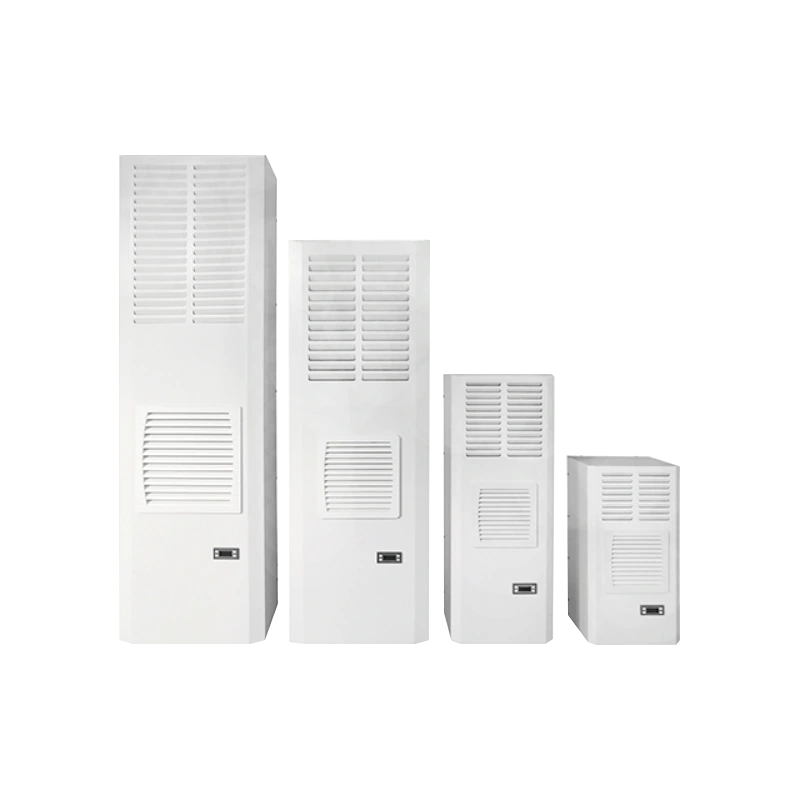
 In terms of operation and maintenance costs, reports from enterprises adopting ODM cooling solutions show that the frequency of preventive maintenance has decreased from once every quarter to once every 18 months, and the cost of replacing cooling components has dropped by 60%. A case of an offshore substation of a certain wind power operator shows that the cooling unit treated for anti-corrosion can operate continuously for over 8,000 hours without failure in a salt spray environment, which is three times longer than the service life of standard products. This customized design reduces the annual maintenance cost of a single station by 45% while maintaining the equipment availability rate at a high level of 99.6%.
With the advancement of Industry 4.0, intelligent cooling systems have become important nodes for data interconnection. A certain steel enterprise uses a cooling device integrated with Internet of Things sensors to monitor in real time the intake air temperature (20-28℃), relative humidity (45%-65%RH), and air flow velocity (0.5-2m/s) of over 2,000 electrical cabinets, with a data sampling frequency of once per second. This system gave a warning of the filter screen blockage fault in the rolling mill control cabinet 37 hours in advance, avoiding a production interruption with an estimated loss of 750,000 yuan. Research shows that the adoption of predictive maintenance cooling solutions can reduce overall operating costs by 18% and increase the comprehensive efficiency of equipment by 22%.
In terms of operation and maintenance costs, reports from enterprises adopting ODM cooling solutions show that the frequency of preventive maintenance has decreased from once every quarter to once every 18 months, and the cost of replacing cooling components has dropped by 60%. A case of an offshore substation of a certain wind power operator shows that the cooling unit treated for anti-corrosion can operate continuously for over 8,000 hours without failure in a salt spray environment, which is three times longer than the service life of standard products. This customized design reduces the annual maintenance cost of a single station by 45% while maintaining the equipment availability rate at a high level of 99.6%.
With the advancement of Industry 4.0, intelligent cooling systems have become important nodes for data interconnection. A certain steel enterprise uses a cooling device integrated with Internet of Things sensors to monitor in real time the intake air temperature (20-28℃), relative humidity (45%-65%RH), and air flow velocity (0.5-2m/s) of over 2,000 electrical cabinets, with a data sampling frequency of once per second. This system gave a warning of the filter screen blockage fault in the rolling mill control cabinet 37 hours in advance, avoiding a production interruption with an estimated loss of 750,000 yuan. Research shows that the adoption of predictive maintenance cooling solutions can reduce overall operating costs by 18% and increase the comprehensive efficiency of equipment by 22%.
Why Is OEM/ODM Electrical Cabinet Cooling Support Important?
In the field of industrial automation, for every 10 degrees Celsius increase in the internal temperature of electrical cabinets, the failure probability of key electronic components will rise by more than 50%. According to research data from IEEE, over 35% of unexpected shutdowns of industrial equipment are caused by insufficient heat dissipation leading to overheating of components. A German car manufacturing plant once had its entire production line shut down for six hours due to a heat dissipation failure of the servo drive, resulting in a direct economic loss of 180,000 euros. Through the customized electrical cabinet cooling solution, the temperature inside the cabinet can be stably controlled at 25±3 degrees Celsius, which can extend the average lifespan of components to 120,000 hours and increase the failure interval time by 40%.
From the perspective of energy efficiency, the energy consumption of traditional fan cooling solutions accounts for 8% to 15% of the total power consumption of the equipment, while the energy consumption proportion of precision air conditioners with intelligent temperature control systems can be reduced to less than 5%. The actual measurement data of a certain semiconductor factory shows that after equipping 200 electrical cabinets with variable frequency cooling systems, the annual electricity bill was reduced by 120,000 US dollars, and the investment payback period was only 11 months. More importantly, the precise temperature control of the cooling system has reduced the temperature fluctuation range of the photolithography machine control cabinet from ±5 degrees Celsius to ±1 degrees Celsius, thereby increasing the product yield by 2.3 percentage points.
In terms of operation and maintenance costs, reports from enterprises adopting ODM cooling solutions show that the frequency of preventive maintenance has decreased from once every quarter to once every 18 months, and the cost of replacing cooling components has dropped by 60%. A case of an offshore substation of a certain wind power operator shows that the cooling unit treated for anti-corrosion can operate continuously for over 8,000 hours without failure in a salt spray environment, which is three times longer than the service life of standard products. This customized design reduces the annual maintenance cost of a single station by 45% while maintaining the equipment availability rate at a high level of 99.6%.
With the advancement of Industry 4.0, intelligent cooling systems have become important nodes for data interconnection. A certain steel enterprise uses a cooling device integrated with Internet of Things sensors to monitor in real time the intake air temperature (20-28℃), relative humidity (45%-65%RH), and air flow velocity (0.5-2m/s) of over 2,000 electrical cabinets, with a data sampling frequency of once per second. This system gave a warning of the filter screen blockage fault in the rolling mill control cabinet 37 hours in advance, avoiding a production interruption with an estimated loss of 750,000 yuan. Research shows that the adoption of predictive maintenance cooling solutions can reduce overall operating costs by 18% and increase the comprehensive efficiency of equipment by 22%.
In terms of operation and maintenance costs, reports from enterprises adopting ODM cooling solutions show that the frequency of preventive maintenance has decreased from once every quarter to once every 18 months, and the cost of replacing cooling components has dropped by 60%. A case of an offshore substation of a certain wind power operator shows that the cooling unit treated for anti-corrosion can operate continuously for over 8,000 hours without failure in a salt spray environment, which is three times longer than the service life of standard products. This customized design reduces the annual maintenance cost of a single station by 45% while maintaining the equipment availability rate at a high level of 99.6%.
With the advancement of Industry 4.0, intelligent cooling systems have become important nodes for data interconnection. A certain steel enterprise uses a cooling device integrated with Internet of Things sensors to monitor in real time the intake air temperature (20-28℃), relative humidity (45%-65%RH), and air flow velocity (0.5-2m/s) of over 2,000 electrical cabinets, with a data sampling frequency of once per second. This system gave a warning of the filter screen blockage fault in the rolling mill control cabinet 37 hours in advance, avoiding a production interruption with an estimated loss of 750,000 yuan. Research shows that the adoption of predictive maintenance cooling solutions can reduce overall operating costs by 18% and increase the comprehensive efficiency of equipment by 22%.